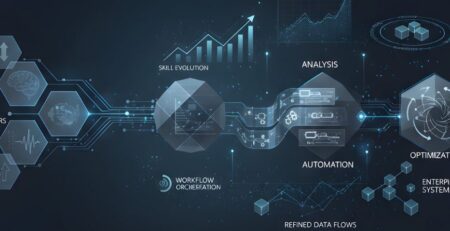

The Agentic Revolution: How Enterprise AI Automation is Unlocking Unprecedented Competitive Advantage
The future of enterprise software solutions is no longer just about static tools, but autonomous, decision-making Agentic AI. This blog post dives deep into how this new generation of Artificial Intelligence, capable of planning, executing, and correcting its own tasks, is fundamentally reshaping Business Intelligence (BI), Data Integration, and Software Product Development. We explore the critical role of robust Data Engineering and seamless API integration in supporting these self-governing systems. Learn how E2ESP’s custom software development expertise ensures your organization is not just adopting AI, but harnessing Agentic AI for true, data-driven competitive advantage.
Introduction: The Dawn of Agentic AI
Moving Beyond Basic Automation
For years, automation meant setting up rigid rules—if X happens, do Y. This was limiting. Today, we stand at the precipice of a new era defined by Agentic AI. An AI agent is a piece of software that can understand a high-level goal, break it down into tasks, plan an execution path, interact with external environments (like software systems or databases), and correct itself when it encounters an obstacle.
Defining Agentic AI
This is far beyond simple robotic process automation (RPA). Agentic AI systems incorporate advanced reasoning, memory, and, critically, the ability to initiate actions without direct human instruction. For enterprises, this means transforming routine operations into fully autonomous processes—the ultimate form of AI automation. Successfully implementing this requires specialized AI development services that connect intelligence directly to mission-critical systems.
The Foundational Pillars: Data Engineering & Integration
The Requirement for Robust Data Engineering
Agentic AI is only as smart as the data it consumes. Therefore, the successful deployment of these systems hinges entirely on world-class Data Engineering. AI agents rely on instantaneous, accurate data to make decisions.
- Data Pipelines: Agents require automated data pipelines and ETL/ELT processes to stream, cleanse, and enrich data in real-time. Without this, agents suffer from poor performance and decision paralysis.
- Data Lakes & Warehouses: Agents use centralized repositories for memory and learning. Managed Cloud Data Lakes and Robust Data Warehouse Architecture are the central nervous system for any large-scale AI deployment.
- Scalability and Resilience: The underlying data infrastructure must be future-proof and handle massive queries from numerous agents simultaneously. E2ESP specializes in building this scalable architecture to prevent bottlenecks in AI automation.
Unlocking Systems with API Integration
An AI agent is useless if it cannot act. Its ability to act in the digital environment is facilitated exclusively by API Integration.
- Tool-Use: Agents use Application Programming Interfaces (APIs) as their “hands” to interface with other systems, whether that’s logging into an ERP system, updating a CRM database, or sending an email.
- Breaking Data Silos: Agentic AI thrives on comprehensive data access. Enterprise API & Data Integration Services are necessary to turn disconnected apps, data silos, and legacy systems into one intelligent ecosystem.
- Legacy Modernization: To ensure agents can interact with all parts of the business, E2ESP offers legacy system modernization and cloud integration services, moving rigid systems into a flexible Hybrid Cloud environment.
Agentic AI in Business Intelligence and Data Analytics
The intersection of Agentic AI and Business Intelligence (BI) is where profound competitive advantage is generated.
Autonomous Decision-Making
Traditional BI is descriptive; you ask the question, and the report gives you the answer. Agentic BI is prescriptive and autonomous:
- Market Analysis Agents: Instead of waiting for a monthly report, an agent continuously monitors market data, competitor pricing, and social sentiment. If it detects a sudden shift, it doesn’t just alert a manager—it initiates a pre-approved, optimized response in the E-commerce platform.
- Predictive Maintenance Agents: In manufacturing, an agent consumes real-time sensor data from machines. When it predicts a failure event (e.g., probability greater than 80% within 48 hours), it autonomously generates a maintenance ticket in the ERP, orders the necessary parts through the procurement API, and schedules the technician, all without human intervention.
- Customer Experience Agents: These agents leverage CRM and Marketing Automation Integration to provide hyper-personalized service. If a high-value customer browses a product but doesn’t buy, the agent crafts and deploys a tailored incentive in real-time.
The Unified Data View
A core function of Agentic AI is achieving a singular, unified view across all data sources. This centralization is the only way agents can make holistic, non-siloed decisions. E2ESP’s focus on Advanced Data Analytics ensures the insights agents generate are meaningful and directly linked to achieving the client’s business goals.
Agentic AI in Custom Software & SaaS Product Development
AI is not just a feature; it’s becoming the underlying operating system for new custom software solutions and SaaS platforms.
Building AI into the Core of Products
When developing a bespoke SaaS platform, the goal is to infuse Generative AI (GenAI) capabilities directly into the core user experience.
- Intelligent Software Products: Agents can automate tasks within the SaaS product itself, from generating boilerplate code for developers to autonomously drafting marketing copy for users. This requires full-lifecycle SaaS development that is built upon future-proof scalable cloud architecture.
- Accelerated Time-to-Market: By using Agile development and incorporating AI tools into the build process, E2ESP ensures a significantly faster Time-to-Market (TTM).
- Flutter for AI Mobile Apps: For mobile applications, the Flutter framework is ideal for deploying AI models rapidly across iOS and Android, ensuring consistent performance and a high ROI on mobile app development.
The Importance of Security and Governance
The more autonomous the AI, the more critical the security and governance structure
- SaaS Security: Agents deal with sensitive data and must operate within strict compliance boundaries. Robust SaaS Security and Quality Assurance (QA) testing are non-negotiable requirements for any platform.
- Risk Mitigation: E2ESP emphasizes a Balanced Data Engineering Approach, ensuring that AI automation is implemented practically, avoiding over-engineering while maintaining auditability and control.
Strategic Partnership: Achieving the Agentic Future with E2ESP
The shift to Agentic AI is complex. It requires not just technology adoption, but strategic transformation across data infrastructure, system integration, and software development methodologies.
E2ESP stands as a comprehensive technology ally, offering the full spectrum of services needed to embrace this new wave of AI automation:
- Full-Cycle Expertise: From AI Product Strategy & Monetization Planning to Ongoing Post-Launch Support & Maintenance, we cover the entire journey.
- Integration Prowess: Our Integration Architects specialize in seamlessly connecting legacy and modern systems, creating the unified ecosystem agents need to execute tasks across ERP, E-commerce, and CRM systems.
- Scalability Guarantee: We design for unmatched enterprise SaaS scalability, ensuring that as your agents grow in number and complexity, your infrastructure keeps pace.
Conclusion: Seizing the Competitive Edge
Agentic AI represents a defining opportunity for enterprises to leapfrog the competition. By moving beyond simple scripts to self-governing systems, companies can achieve efficiencies, generate insights, and deliver experiences that were previously impossible. The path to this future is paved with superior Data Engineering and Advanced API Integration. Partner with E2ESP to ensure your journey into AI automation is built on a resilient, scalable, and strategically sound foundation