How AI Accounting Agents Handle Exceptions in Accounting Workflows
Most accounting automation projects clear their first hurdle without much drama. Invoices that match purchase orders flow through. Recurring journal entries post on schedule. Bank feeds reconcile against the general ledger without anyone having to lift a finger. But the trouble starts the second something doesn’t fit the pattern, like a duplicate invoice from a vendor that renamed itself after that acquisition, or a reconciliation that’s off by a few hundred dollars, for reasons nobody can immediately lay out. Then there’s the approval that isn’t there because the approver left the company three weeks ago, and it’s been sitting there.
The hard part was never spotting that something is wrong. Most rules engines can flag a variance or a mismatch without much sophistication. The hard part is figuring out why it’s wrong, what evidence would actually resolve it, whether it’s safe to act without a human, and if not, who should be looped in and with what context already assembled for them. That’s a fundamentally different problem than transaction processing, and it’s the one AI accounting agents are increasingly built to solve.
This piece looks at how that resolution process actually works: how an AI accounting agents investigate an exception, decides what it’s confident enough to act on, and knows when to step back and hand the decision to a person. This is the terrain we spend most of our time in: not building automation for the easy 80%, but designing the reasoning and integration layer that handles the harder remainder without turning it into a black box nobody trusts.
What Happens When an Accounting Workflow Hits an Exception?
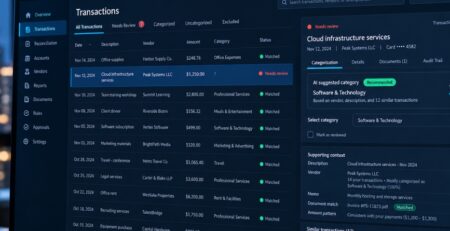
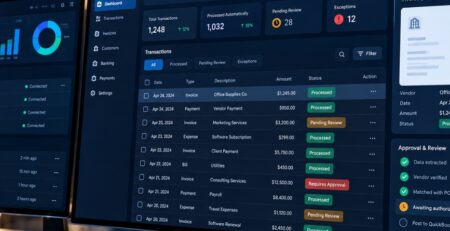
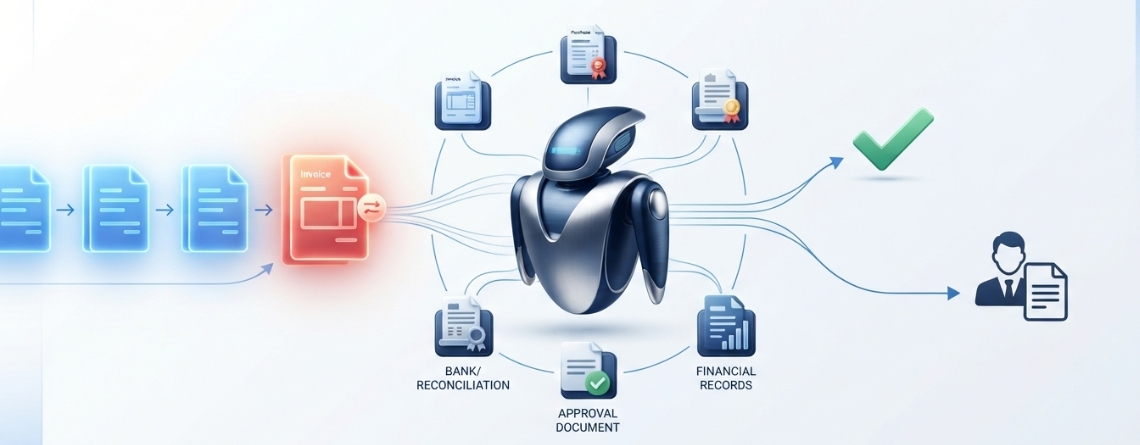
An exception is not necessarily a dead end. It is basically one of those fork points in the workflow. Rather than just flat-out rejecting the transaction, an AI agent can quietly pull together the right context, figure out what kind of problem it is, plus the level of danger involved, then choose a fitting resolution path, either fix it on the spot or send it along for human review, with a clear audit trail behind it.
Rule based automation can work pretty well when the conditions are predictable and already set. But exceptions are kind of different; they usually need some context, a bit of interpretation, and also a real risk assessment. A variance that looks minor in one transaction might turn out to be actually material in another, and the stuff needed to settle it may be sitting around across procurement, accounting, various documents, or even other enterprise business systems.
How an AI Agent Processes an Accounting Exception
This is basically the operational core of exception handling, and it is worth stepping through it systematically, because the order really matters as much as any single capability.
1. Detect the Exception
Detection really does reach a lot wider than most folks picture at first. An AI accounting agent ought to keep an eye on missing bits, like a PO number that somehow never made it onto the invoice, plus data inconsistencies, such as a vendor’s tax ID that doesn’t quite match what’s on file. Also watch for duplicate transactions, amounts that sit outside the usual ranges, policy violations, reconciliations that fail to settle, approval gaps, and journal entries that look odd compared to the entity’s past patterns.
And honestly, that breadth is the point here; tighter detection rules, or just narrow checks, tend to move the same problem further downstream where it’s harder and more expensive to catch.
2. Classify the Exception
Not all exceptions are the same kind of headache, and if you treat them like they’re the same species, you end up with those generic, ineffective fixes, as if that’s the whole story. For AI agents in accounting, you kind of have to sort out whether it’s a data-quality snag, an invoice exception, a reconciliation exception, a coding or classification mismatch, an approval exception, a policy exception, and also anything that carries compliance implications. Classification sort of decides basically everything after that, like which evidence is actually needed, which resolution routes are even allowed, and who should have visibility into it in the first place.
3. Gather Supporting Context
This is where a lot of exception-handling tools fall short, and it’s one of the areas we push hardest on in custom implementations. An agent that can only see the connected accounting system is kinda half blind, you know. When a real exception pops up, fixing it usually means having to pull details from the ERP integration, procurement system, CRM, banking or payment platforms, plus document storehouses where the original invoice or agreement actually lives. And yeah, sometimes even from email logs or approval-chain records as well.
Consider a price variance on an invoice. The accounting system shows a mismatch. The procurement system might show an approved change order that explains it. Without that second data point, the agent or the human it escalates to is guessing. The investigation has to happen before the decision not instead of it.
4. Identify the Root Cause
Once the context is all pieced together, the agent has to somehow separate a data issue, like a typo or a stale vendor record, from a process issue like an approval step that keeps getting skipped. AI agent monitoring can help track these issues over time. It also should look at whether this is just an isolated incident or more like a sign of something repeating, because the same vendor triggering the same mismatch every month is a totally different kind of conversation than a one-off anomaly.
5. Assess Risk and Confidence
This is a step many automation efforts get wrong by collapsing it into a single confidence score. Confidence in a proposed resolution matters, but it shouldn’t be the only variable determining whether the agent acts alone. Transaction value, financial impact, how sensitive the relevant policy is, compliance exposure, the strength of supporting evidence, and critically whether the action can be reversed if it turns out to be wrong all need to factor into the decision. A highly confident agent making an irreversible six-figure adjustment deserves more scrutiny than a moderately confident agent flagging a $40 coding error.
6. Select the Appropriate Resolution Path
In practice, it really comes down to three realistic choices: resolve it automatically, prepare a recommendation and ask for sign-off, or push it to a human but with the investigation already done. Which one is correct depends on all the stuff gathered in those earlier steps, not some fixed, boring rule like “invoices under $500 auto-approve”. A $200 invoice with conflicting vendor data deserves more caution than a $2,000 invoice that matches its PO exactly.
7. Execute or Route the Resolution
Depending on how the permissions are built into the system, the agent might correct a data field, update a GL classification, ask for missing documentation from a vendor or employee, send an approval to the right person, put a transaction on hold, or simply prep a recommendation for a human to take action on. What the agent is allowed to do should be a very deliberate design call, not something that just defaults. Strong controls around these kinds of actions can also help with steadier AI workflow performance.
8. Document the Decision
Every exception should leave behind a clear record: what was detected, what evidence was considered, what the agent’s reasoning and recommendation were, what action was ultimately taken, who approved it if a human was involved, and what the outcome was. This isn’t exactly a nice-to-have or anything casual. Auditors, controllers, and regulators will eventually ask why a transaction was handled the way it was, and “the AI did it” is not an acceptable answer at all. A defensible audit trail is what separates a production-grade AI exception management from a demo.
Accounting Exception Scenarios AI Agents Can Handle
Abstract descriptions of exception handling only go so far. Here’s how the process plays out against specific, common scenarios.
Duplicate Transaction or Invoice
The AI accounting agents figure out there might be a duplicate, then it checks it against records that look alike, like invoice number, total amount, the vendor, and how close the date is. After that, it judges how confident it is that both entries are really the same transaction. If it’s not clear enough, it keeps the newer record aside for review, or it just resolves the matter right away when the match feels unambiguous. Finally, it writes down what it compared and what result it landed on.
Invoice and Purchase Order Mismatch
These break down into a few recognizable patterns: price variance, quantity variance, a missing PO reference entirely, or a vendor name or banking detail that doesn’t align with what’s on file. Each of these calls for a different kind of context. A price variance points the agent toward procurement records for an approved change order. A vendor mismatch points toward verifying against the vendor master file and possibly flagging a fraud risk rather than a simple data error.
Reconciliation Exception
The agent compares the two sets of records that are used for reconciliation and isolates the specific line items that don’t match, then pulls in supporting transactions that could explain the gap (like a payment in transit or a bank fee not yet booked). This approach can help address some of the broader financial reconciliation challenges that emerge as transaction volume and system complexity increase. After that, they work through the most likely causes and either prepare a resolution or escalate with the investigation already documented, so the accountant doesn’t have to do all that manual detective work.
Ambiguous Account or Transaction Classification
When a transaction doesn’t clearly map to a GL account, the agent can look at how similar transactions were classified historically, review any supporting documentation attached to the transaction, apply the entity’s account rules, and recommend a classification. Where the historical pattern is inconsistent, or the evidence is thin, escalation is the right call; guessing on classification has downstream tax and reporting consequences that aren’t worth the risk of getting it wrong.
Unusual Journal Entry
Journal entries carry outsized risk because they bypass normal transactional controls, which makes them a common vector for both error and fraud. An agent should be comparing entries against historical patterns for that account and preparer, checking whether supporting documentation exists, and applying stricter approval controls by default. This is a category where routing for human review should be the norm rather than the exception, regardless of how confident the underlying model is.
Missing Approval or Documentation
Instead of just making a transaction fail because that required approval, or a needed document is absent, the AI accounting agents can figure out what is actually missing, not in a vague way but pretty exact, and then route the request to whoever can provide it: the original approver, a delegate, or, in other words, the person that holds the relevant vendor relationship. So it turns what would’ve been a dead-end failure into a workflow step that can actually be resolved.
When Should an AI Agent Resolve an Exception vs Escalate It?
This is the decision that determines whether an exception handling system earns trust or erodes it. A practical framework looks something like this:
| Situation | Recommended Action |
| Low-risk + high confidence + sufficient evidence | Automate |
| Low-risk + moderate confidence | Recommend + human review |
| High-value transaction | Human approval required |
| Compliance-sensitive issue | Escalate |
| Conflicting data across systems | Investigate, then review |
| Insufficient evidence | Request additional information |
| Unusual journal entry | Human review by default |
| Repeated exception pattern | Investigate root cause, don’t just resolve instances |
Notice that confidence appears only once in this table, and it’s not sufficient on its own even there. A resolution path should reflect financial exposure and reversibility as much as it reflects how sure the model is.
Why Human-in-the-Loop Controls Matter
The objective is not removing accountants from the process; it’s removing the manual burden that shouldn’t require a person in the first place, while keeping people firmly in the loop where financial risk actually warrants their judgment. The deployments that hold up over time are consistently the ones that preserve meaningful human oversight at genuine decision points, rather than automating everything indiscriminately and hoping the model doesn’t make an expensive mistake at scale. Controllers we work with don’t want an agent that never asks for help. They want one that asks for help at the right moments and stops asking for help on the things it’s demonstrably good at.
How AI Agents Handle Exceptions Across Connected Systems
The Accounting System Is Only One Source of Context
An exception that shows up in the ledger frequently originates somewhere else: the invoice discrepancy traces back to procurement, the reconciliation gap traces back to the payment processor. An AI agent cannot reliably resolve accounting exceptions with limited access to the information it needs.
Cross-System Exception Investigation
A realistic trail runs from the invoice system through procurement, into accounting, through approvals, and out to accounts payable automation. Every handoff is a spot where a sort of inconsistency can sneak in, and often the inconsistency between systems is the exception, not really something that’s calmly hiding downstream of it. A well-built agent will treat data drift as a first-class kind of exception category, not a weird edge case that you only notice later.
Maintaining Data and Workflow Consistency
Cross system resolution needs clear answers upfront: which system is the authoritative source for a given data element, how sync failures get surfaced, what the agent can read versus write in each system, and how transaction integrity holds when a resolution touches more than one platform. This is standard accounting system integration discipline; the stakes just rise when the actor making changes is autonomous.
Designing Controls for AI-Driven Accounting Exception Handling
Capability isn’t the hard part anymore. Governance is what separates a demo from a system a CFO will put in front of auditors.
- Permission and Action Boundaries
Every agent needs an explicit answer: what can it read, recommend, change directly, or require sign-off for? These boundaries should be set per exception type and per system, not inherited as a blanket default.
- Approval Thresholds
Thresholds shouldn’t be flat. Low-value transactions can tolerate more autonomy. High-value transactions and sensitive changes, reserve adjustments, intercompany entries, and manual journal postings warrant tighter thresholds and often dual approval, regardless of the agent’s own confidence score.
- Audit Trails and Reversibility
Every exception record should capture what was detected, the evidence considered, the agent’s reasoning, the action taken, the approver if one was involved, and the outcome; this supports SOX compliance and standard audit expectations. And because agents will occasionally get it wrong, there needs to be a clear rollback path: a change log detailed enough to reconstruct and reverse a bad decision cleanly. Systems without that baked in tend to lose trust the first time something goes sideways.
- Data Access and Security
Exception handling routinely touches vendor banking details and sensitive financial data across systems. Access should be scoped tightly to what a given exception actually requires. SOC 2 and least-privilege principles are a reasonable baseline, especially where the agent is writing to systems of record.
Build an Exception-Handling System That Finance Actually Trusts
AI Accounting agents can meaningfully cut the manual load exceptions create in accounting workflows, but only when they’re built with the right context, the right controls, and the right human checkpoints. E2E designs AI agents for accounting exception management, workflow automation, and integration across ERP, procurement, and finance systems, built for auditability and enterprise-grade reliability from day one. If exceptions are still consuming your finance system integration team’s time, let’s talk about what a properly integrated AI agent could take off their plate.