Financial Reconciliation Challenges AI Accounting Agents Can Solve
Many finance leaders think reconciliation trouble is mainly about headcount. They add more analysts. They extend the close timeline. They buy another part of the ERP. In practice, that often does not fix it. Even when a company has a mature ERP, solid accounting tools, and working payment systems, the close can still slip. Exceptions can still roll into the next period. Senior accountants can still spend time on tasks that do not really require judgment. The issue is not truly inside the systems. The systems have the data. The tools can talk to each other. The gap is in the day to day process, the financial workflow automation. There should be a layer that looks at a mismatch, pulls in the right details, and then picks the next step.
The costs grow in the background. Slow reconciliation keeps piling up. Those delays also push the reporting back. In the end, some exceptions stay open, and that becomes a control risk. Simply adding more reviewers does not solve the real issue. The work stays split up, and the same manual checks get done again by more people. The real fix is redesigning how transactions get matched, investigated, and corrected, which is exactly where AI accounting agents earn their place. The financial reconciliation challenges covered here are not edge cases; they are the default state for any finance function that has scaled past a handful of entities, currencies, or payment channels.
Why Financial Reconciliation Challenges Emerge as Operations Scale
- Financial Reconciliation challenges rarely show up when a company is small: they show up when volume and complexity outpace a workflow built for a simpler business. But once volume jumps into the tens of thousands across different companies and currencies, it falls behind fast. To keep up, staffing would need to grow at about the same rate. Most finance teams cannot do that. Budgets also do not rise in a straight line.
- The data is spread out too. You may see transaction pieces in an ERP, bank feeds, card processors, and payment gateways. Each system stores its own view. The fields do not line up well. So the same transaction gets pieced together by people instead of software.
- Matching based on fixed rules also breaks down. It can work when every detail matches, like IDs, exact amounts, and the same dates. But real life adds changes. A batch payment can shift how records appear. Small FX rounding differences can break the expected amounts. Then the system calls it an exception, even when it is clearly the same thing.
- Exceptions require too much manual investigation: Flagging a mismatch is the easy part. Determining why it happened- a timing difference, duplicate entry, incorrect GL coding, or a genuine error requires pulling records from several systems and reconstructing a timeline.
- Finance teams discover problems too late in the close cycle: Because reconciliation is often batched to periodic reviews rather than run continuously, errors surface days before reporting deadlines, when there’s the least time to investigate them properly.
Problem 1: Too Many Transactions Require Manual Matching
What This Looks Like in Practice
Finance teams end up manually comparing ERP entries against bank statements, card processor settlements, and payment gateway records line by line, in many organizations, on a rolling basis. A few small changes trip up a rules engine. It might be a $0.03 FX rounding gap, or a payment that lands two days after the invoice date. When everything lines up, older automation can handle it. That means exact matches, clear references, and dates that fall right on schedule. But those neat cases are getting less common. As the business grows and uses more payment options, the share of easy matches keeps shrinking.
How AI Accounting Agents Solve It
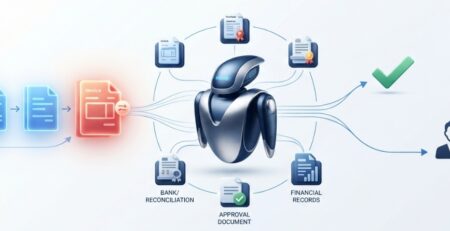
A strict exact match is not the only option. An AI accounting agent looks at several transaction details together, like the amount, the counterparty, the date range, and how close the description is. It also checks past behavior and then combines all those signals. In practice, it may learn that a certain vendor usually pays about three days after the invoice date. It can also notice that one customer’s payments often come in after a processing fee is taken out. Each potential match gets a confidence score. High-confidence matches clear automatically. Anything below the threshold gets escalated to a human reviewer, with the reasoning attached rather than a bare flag.
Business Impact
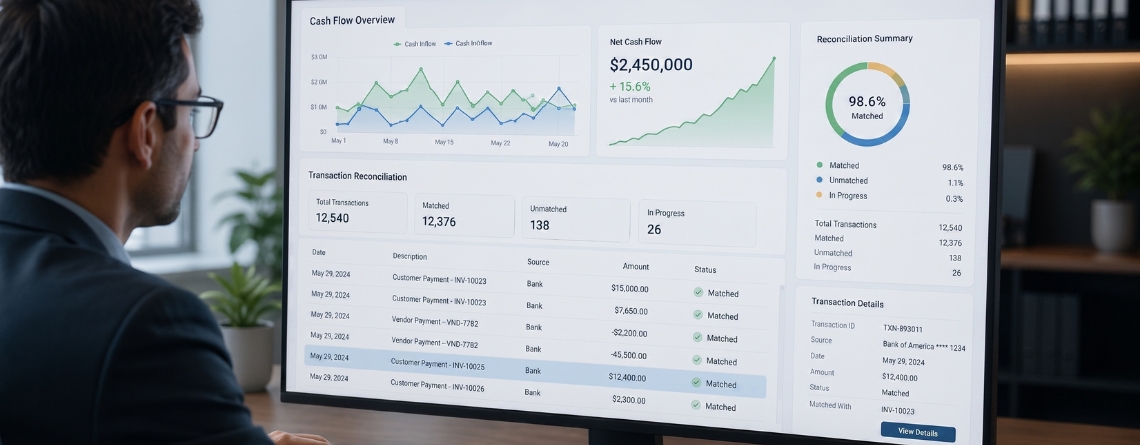
The direct result is a materially higher auto-match rate, which translates into lower day-to-day reconciliation workload and a faster daily and month-end process. The finance team’s time shifts from repetitive comparison work to reviewing the smaller number of transactions that genuinely need judgment.
Problem 2: Exception Queues Keep Growing
Why Traditional Automation Fails
Most existing automated transaction matching tools stop at detection. They tell you a transaction did not match; they do not tell you why. Even with automation, the finance team has to do the real checking. They still need to log into the ERP, open the bank portal, and review the vendor tools. In some cases, they also have to pull up old email threads to piece together what actually took place. If you automate without any real review, you just shift where the delay shows up.
How AI Agents Change the Workflow
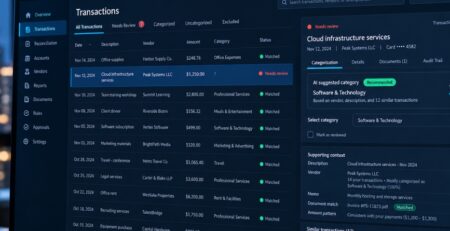
An AI agent that exception handling in accounting does more than raise an alert. It gathers the linked invoices, payments, journal entries, and vendor files on its own. Then it looks at the full set to suggest what most likely went wrong, like a duplicate payment, a timing slip, or a wrong remittance amount.
After that, it offers a fix you can take. If the situation seems large or if the details are not clear, it routes the case to a person for a review. When the system feels confident and the risk is small, it ends the item or moves it into a basic approval list.
Business Impact
Exception resolution cycles shorten measurably, the backlog stops compounding month over month, and senior finance staff stop spending hours on investigative legwork that adds no strategic value.
Problem 3: Reconciliation Is Still a Month-End Fire Drill
The Operational Problem
In most organizations, reconciliation issues accumulate silently throughout the month. Most people do not catch a wrong invoice or a payment posted to the wrong spot until the end of the month is close. Then the team is already in reconciliation mode and trying to finish fast. At that point, a problem from three weeks ago is harder to unwind; it pulls in more staff, and it can end with a quick fix instead of a tidy solution.
AI agents help with ongoing reconciliation
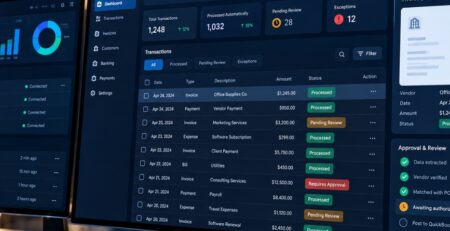
Don’t handle reconciliation only now and then. Make it a regular step. An AI tool can watch for new transactions as they come in. It can flag any mismatches fast. Then it can begin the review right away. That means the exceptions stay at a steady level. You avoid a sudden pileup right before the reporting window.
Business Impact
This is one of the more direct levers on close speed. Companies see fewer last minute corrections, a more predictable close calendar, and less of the adrenaline driven scramble that tends to introduce its own errors.
Problem 4: Finance Teams Spend Too Much Time Finding Context
Why This Becomes Expensive
Resolving a single exception often requires checking three, four, or five separate applications: the ERP for the GL entry, the bank portal for settlement detail, the AP system for the original invoice, maybe a vendor portal for a remittance advice. A skilled accountant’s time gets consumed gathering information rather than exercising the judgment they are actually paid for. This is one of the least visible costs in finance operations, because it does not show up as a line item; it shows up as slower throughput and quiet burnout.
AI agents can cut the time spent on investigations
If an agent can reach your linked finance tools, it can pull the right records on its own. Then it can put those records in one place and explain what shifted. The agent can also say what likely caused the change, using clear wording instead of sending raw files.
It helps the reviewer by pointing to a suggested next step. So the reviewer does not begin from zero. Because of that, what could take around twenty minutes to find can be settled in roughly a minute and a half.
Business Impact
Less application switching, more productive finance teams, and a meaningfully lower cost per exception resolved a metric worth tracking on its own, since it captures labor cost more precisely than headcount alone.
Problem 5: Incorrect Coding Creates Repeating Reconciliation Issues
Why the Same Errors Keep Returning
A lot of the recurring reconciliation issues keep pointing to the same few causes. First, some items land in the wrong GL account. Second, the vendor details do not match from one place to the next.
Third, the same kind of transaction gets entered in different ways each month, based on whoever is handling it. When someone fixes a record by hand, that stops the problem for that one cycle. But it does not change the underlying setup. So the same exception shows up again in the next period and keeps coming back after that.
How AI Accounting Agents Help
Because an AI agent sees every transaction that flows through the financial reconciliation process, it can identify recurring classification patterns across periods, not just within one. It can detect unusual postings that deviate from a vendor’s or account’s historical pattern, recommend a GL correction rather than a temporary override, and flag repeat root causes as a candidate for a process fix rather than another one-off adjustment.
Business Impact
We have had fewer repeat exceptions. The financial data quality is better overall. That means the team doing consolidated reporting has less cleanup work after the fact.
Problem 6: Full Automation Creates Control Risk
The Wrong Approach
When an AI agent is allowed to make corrections on its own, it can change journal entries, clear exceptions, or move transactions to new categories. If nobody checks it first, this is a control gap that will likely show up later. Even if the model is right most of the time, that is not the key point. Auditors, regulators, and board members want clear ownership and a clear sign off process. They focus on who is accountable, not on averages.
A Better Operating Model
The more defensible approach is to explicitly define what the agent can do at each stage:
- Match automatically: for high-confidence, low-risk transactions
- Recommend: for exceptions that need a human decision
- Correct: only within pre-approved, narrowly scoped categories
- Escalate: anything outside defined thresholds
- Never change without approval: for anything touching material accounts, unusual patterns, or high-risk classifications
Approval thresholds should scale with transaction value, the agent’s confidence score, account type, overall risk level, and materiality the same variables a controller would already use to decide how closely to review something manually.
Business Impact
Done this way, automation does not come at the expense of financial governance. It preserves clear accountability for every correction and produces a stronger audit trail than most manual processes ever did, since every agent decision and every human approval is logged.
Where AI Accounting Agents Deliver the Highest ROI
Some reconciliation workflows do not work well when you try to automate them. In early AI programs, teams often treat every case as the same. That can be a bad move. The organizations that get the best return are the ones that map their financial reconciliation challenges by cost and risk before choosing where to deploy an agent, rather than automating whatever happens to be easiest. The workflows worth prioritizing share a specific profile: large transaction volumes, repetitive exception patterns, high manual reconciliation investigation time, involvement of multiple connected financial systems, and reasonably well-defined approval rules. Significant month end reconciliation workload is usually a strong signal too, since it means the current process is already expensive in labor terms.
A simple way to frame the decision:
- High volume + repetitive + low judgment = automate first. Think bank-to-ERP matching, recurring vendor payments, standard intercompany transactions.
- Low volume + high judgment + high risk = keep human-led. Complex accruals, non-standard revenue recognition, anything with material financial statement impact.
This framework matters more than it sounds; it is the difference between an AI reconciliation rollout that delivers ROI in the first quarter and one that stalls because it tried to automate the hardest cases first.
What Your AI Reconciliation Architecture Needs to Work
None of this works without the right underlying architecture, and this is where a lot of accounting workflow automation initiatives underdeliver, not because the model is weak, but because the integration layer around it is. At minimum, it needs reliable ERP and banking integrations with clean, timely data, access to supporting financial documents like invoices and remittances, and clearly defined agent permissions with human approval checkpoints and escalation rules so nothing falls through undefined territory.
Audit logs and ongoing monitoring of agent decisions round out the requirements not as a compliance afterthought, but as the mechanism that lets finance leadership trust the system enough to expand its scope over time. This is the foundation E2E builds first on every engagement, because it is what separates real financial accounting reconciliation improvement from a pilot that never scales, and it is ultimately what determines whether a company’s financial reconciliation challenges actually get solved or just get automated reconciliation in place.
A Practical Rollout Strategy for Finance Leaders
- Start with your highest-cost workflow. Pick the reconciliation job that hits hardest and costs the most, bank reconciliation, intercompany tie-outs, or a crowded set of vendor accounts. Do not spread effort across every problem at once.
- Automate matching and investigation first. Let the tool handle matching and pull the key facts, but keep final review and corrections with your team. This proves the system works before it takes any real action.
- Introduce controlled agent actions gradually. Once results hold up, let the agent resolve specific low-risk exceptions high-volume, low-risk cases only, and only within rules you have already approved.
- Expand once the first workflow is proven. Move to other financial workflows only after you have clear evidence of accuracy, strong controls, and a solid payoff, not in parallel with the first rollout.
Fix the Reconciliation Workflow, Not Just the Task
Most finance groups run into financial reconciliation challenges because their workflow is split up. It is rarely due to not enough people to review. It is also not usually because the ERP is missing a feature.
AI tools can help, but the real payoff shows up in three areas. First, they cut down the time spent digging into issues. Next, they lower how often exceptions come up. Finally, they reduce the amount of manual choices staff have to make. None of that happens by deploying a model in isolation; the strongest implementations combine AI capability with solid financial system integration, clearly defined controls, and human oversight at the points that matter.
The objective was never “AI-powered accounting” as an end in itself. It is a faster, more controlled financial operation where the close calendar shrinks, the exception queue stays manageable, and finance talent spends its time on judgment rather than lookup.
Ready to Fix Your Reconciliation Workflow?
If reconciliation is slowing your close, increasing exception backlogs, or consuming valuable finance-team time, talk to E2E about designing AI accounting agents around your financial workflows and controls.