
Custom QuickBooks AI Agents: Costs, Features, and Value
Custom QuickBooks AI agents present investment questions when accounting operations continue to grow despite the current level of automation. Leaders must be able to determine the work the agent will finish, its implementation requirements and its ability to justify the remaining expenditure before approving its development.
It depends on the accounting rules, connected systems and review requirements that the proposed solution addresses. A viable proposal will tie these requirements to the expected results and factor in the cost of continued operation of the workflow after launch.
When Custom QuickBooks AI Agents Are Worth Considering
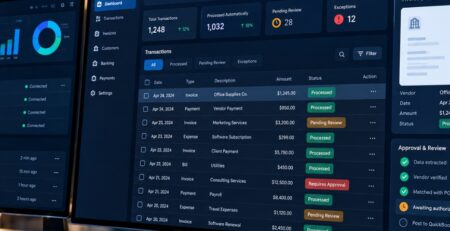
Consider a media technology company that receives invoices via email, stores contracts in a document repository, and has campaign approvals stored in a different internal platform. QB handles the accounting records but employees still need to collect all the evidence required to bill each invoice.
Custom QB automation might be something to consider if this process takes a lot of time or causes billing and closing delays. The same goes for increasing transaction volumes creating more work for reviewers or varying approval rules per department.
Consider existing QB capabilities and off the shelf solutions before embarking on custom development, which will require additional resources to maintain.
Features to Include Based on Your Accounting Requirements
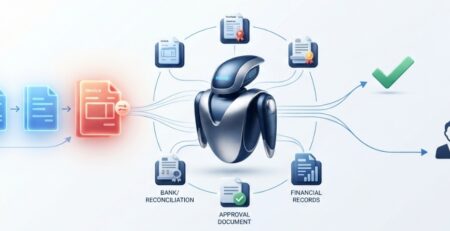
Define capabilities around the work that needs completing. An agent might retrieve an invoice, compare it with supporting records, propose a category and route the result for approval before an authorized update.
| Feature area | Business purpose |
| Business-system connections | Retrieve relevant contracts, customer records and payment details |
| Document and transaction review | Identify missing information and conflicting records |
| Business-rule checks | Test proposed actions against accounting requirements |
| Approval routing | Obtain the appropriate authorization |
| Exception handling | Escalate unresolved items with supporting evidence |
| Activity records and monitoring | Track actions, failures, and outcomes |
These are potential project capabilities. AI transaction categorization may require document interpretation, while amount checks and approval thresholds can use conventional code. Accounting workflow integration should combine these methods according to the task.
What Determines QuickBooks AI Implementation Costs?
A proper evaluation of the costs of implementing QuickBooks AI would require sample sets of records, a flow of actions, the access requirements, and approved actions.
Number and Complexity of Associated Systems
The connection of QuickBooks API Integration to one billing system is much less complex than connecting multiple internal applications. Intuit publishes information about API throttling, and the production estimates would require accounting for interruptions and resubmission of entries without duplicates.
Workflow Scope and Decisions Required
Preparing recommendations would require different controls than posting transactions. Multiple approval stages, departments, and exceptions would increase the required development and testing effort. The statement of work should include which transaction approvals are left to finance.
Data Quality and Preparation Effort
Duplicates, missing references, and varied vendor identifiers prevent reliable reconciliation. Assigning record ownership for correction before implementation will prevent unaccounted expenses. Record quality would delay implementation if not discovered during testing.
Testing, Deployment, and Acceptance Requirements
The testing set should include ambiguous and rejected records in addition to test data. Acceptance criteria should state account controls, permissions, duplicates, and recovery procedures. A rollout plan limits the workload when individual approvals are required that aren’t yet automated.
Operations and Support Costs
Reserve budget funds for hosting, model usage, monitoring, and support. The responsibility for failed jobs and renewal of access is a critical concern. A low cost of inference does not equal a low cost of operations.
Which Features Justify the Investment for Your Business?
Prioritize capabilities that take away a bottleneck in the process. A conversational UI can wait if reviewers still have to spend twenty minutes finding the contract associated with the invoice.
In the example use case of a media company, invoice extraction alone would save data entry time, but it wouldn’t help with the contract check and approval process. If we were to link extraction, find the associated contract, check for variances, and route to the appropriate reviewers, we could free up even more time throughout the entire process.
That broader scope also costs more. Compare the additional time released with development and maintenance requirements before expanding it. Several disconnected features can look impressive while leaving the most expensive work unchanged.
Evaluating Business Value Through Costs, Returns, and Operational Impact
Establish the baseline across processing, investigation, follow-ups, and corrections. QuickBooks automation ROI should include the manual work remaining after deployment and the recurring cost of running the solution.
For illustration, 2,000 monthly items taking six minutes each represent 200 handling hours. Reducing average handling to three minutes releases 100 hours. Those hours become cash savings only if spending falls or a planned hire is avoided; otherwise, they represent capacity for other work.
Track:
- Manual handling time per transaction.
- Number of manual handoffs.
- Time required to resolve exceptions.
- Percentage completed within agreed controls.
- Monthly operating and support cost.
Compare like-for-like workloads. An improved average can conceal a growing backlog of difficult transactions, particularly during financial reconciliation at month-end.
How Exception Handling Affects Cost and Value
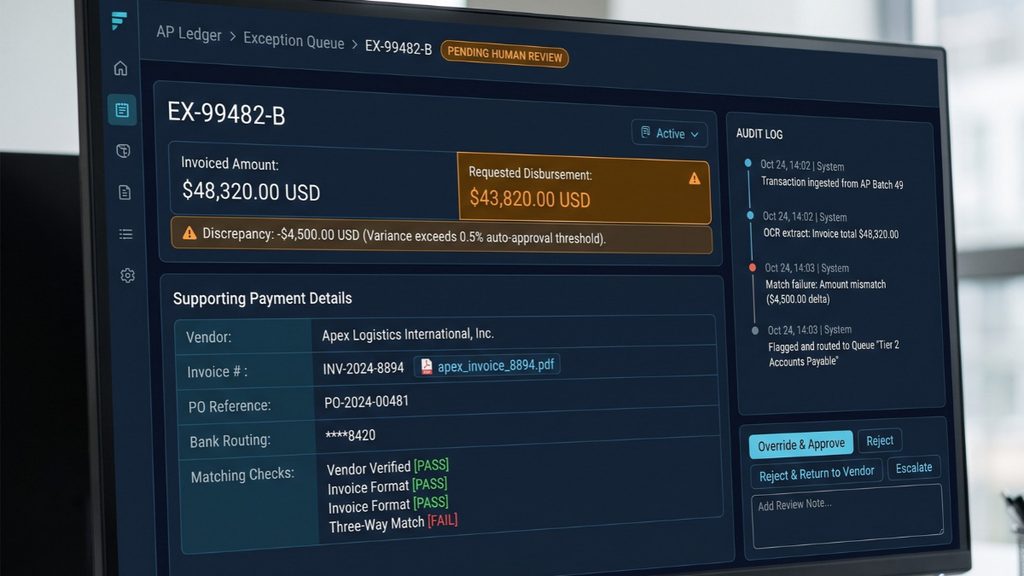
Accounting exception management can determine whether the investment delivers its expected return. Flagging a mismatch saves little when a reviewer must still investigate it from scratch.
For example, a payment-platform settlement may combine customer payments, fees, and refunds. A useful agent would assemble those records and present a supported matching proposal. Unresolved differences would remain for review, with clear ownership.
Our article on how AI accounting agents handle exceptions in accounting workflows examines that process in detail.
The proposal should also define retained evidence, reviewer permissions, and escalation responsibility. NIST’s voluntary AI Risk Management Framework offers a useful governance reference through its Govern, Map, Measure, and Manage functions. Applying it does not certify accounting accuracy or regulatory compliance.
What a Project Proposal Should Make Clear
Before commissioning QuickBooks workflow automation, require a proposal that identifies:
- Included workflows, connected systems, and deliverables.
- Permitted actions and mandatory human approvals.
- Acceptance criteria using representative transactions.
- Pricing assumptions, exclusions, and recurring charges.
- Code ownership, documentation, maintenance, and support responsibilities.
Ask what happens when a transaction cannot be completed or a connected service becomes unavailable. For a CTO assessing delivery risk, those answers matter as much as the demonstration. For finance, acceptance should depend on correct accounting outcomes and traceable authorization.
How E2ESP Scopes Custom QuickBooks AI Agents
E2ESP’s QuickBooks AI Agents & Automation services focus on accounting rules, approval requirements, and existing business systems. The scope should connect those requirements to defined features, controls, and measurable success criteria.
When assessing QuickBooks automation services or broader AI accounting integration solutions, clarify where existing tools already fit and where custom development adds value. Agree on implementation boundaries and ongoing ownership before committing the budget.